Current Projects in the Lab:
Soil Carbon Interactions with Minerals under Fluctuating Hydrologic Conditions
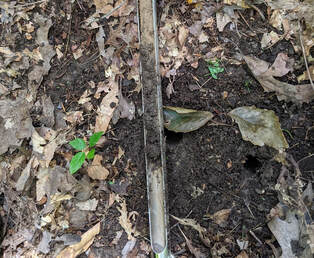
Soil carbon is the largest pool of organic carbon on the surface of the Earth, and preserving this carbon in soils is critical to keeping our climate liveable in the long term. Chemical reactions between soil minerals and soil carbon are one of the primary ways that soil carbon is stabilized in the soil and protected from microbial decomposition. Our lab looks at how fluctuating soil moisture conditions, which drive changes in soil oxygen availability and redox status, alter the stability of these soil carbon-mineral associations and the rates of microbial decomposition of carbon. Another axis of this work explores how the molecular characteristics of soil carbon changes the pathways by which soil carbon is stabilized by mineral surfaces and the degree to which microbes are involved in this stabilization. Our approach is primarily experimental, involving lab and greenhouse work. This work is led by Ph.D. student Fiona Ellsworth, and is funded by the Department of Energy, Division of Environmental and Earth System Science.
Soil carbon is the largest pool of organic carbon on the surface of the Earth, and preserving this carbon in soils is critical to keeping our climate liveable in the long term. Chemical reactions between soil minerals and soil carbon are one of the primary ways that soil carbon is stabilized in the soil and protected from microbial decomposition. Our lab looks at how fluctuating soil moisture conditions, which drive changes in soil oxygen availability and redox status, alter the stability of these soil carbon-mineral associations and the rates of microbial decomposition of carbon. Another axis of this work explores how the molecular characteristics of soil carbon changes the pathways by which soil carbon is stabilized by mineral surfaces and the degree to which microbes are involved in this stabilization. Our approach is primarily experimental, involving lab and greenhouse work. This work is led by Ph.D. student Fiona Ellsworth, and is funded by the Department of Energy, Division of Environmental and Earth System Science.

Watershed Solute Export during Rain-on-Snow Events
Rain-on-snow events can trigger massive export of solutes from watersheds, owing to the rapid mobilization of snowmelt and conveyance of groundwater to receiving streams. In this project, we are working to document the prevalence of rain-on-snow events across the continental US, determine if the prevalence is changing due to climate change, and qunantify how much these events contribute to total annual solute fluxes from small watersheds. In this work, we are synthesizing large-scale spatial datasets of snow cover, precipitation intensity, hydrolgic discharge, and water chemistry. We are interested in solutes of both biogenic (e.g. dissolved organic carbon, nitrate) and geogenic origin (e.g. silica, calcium), and we hope to further leverage this data to infer how rain-on-snow events differ from other precipitation events with regard to subsurface flow dynamics. This work is in collaboration with Erin Seybold (Kansas Geological Survey) and John Gardner (Pitt).
Marinos, R. E. (2021). SNODASR: Tools for manipulating SNODAS data in R (Version 1.0). doi:10.5281/zenodo.4568272
Rain-on-snow events can trigger massive export of solutes from watersheds, owing to the rapid mobilization of snowmelt and conveyance of groundwater to receiving streams. In this project, we are working to document the prevalence of rain-on-snow events across the continental US, determine if the prevalence is changing due to climate change, and qunantify how much these events contribute to total annual solute fluxes from small watersheds. In this work, we are synthesizing large-scale spatial datasets of snow cover, precipitation intensity, hydrolgic discharge, and water chemistry. We are interested in solutes of both biogenic (e.g. dissolved organic carbon, nitrate) and geogenic origin (e.g. silica, calcium), and we hope to further leverage this data to infer how rain-on-snow events differ from other precipitation events with regard to subsurface flow dynamics. This work is in collaboration with Erin Seybold (Kansas Geological Survey) and John Gardner (Pitt).
Marinos, R. E. (2021). SNODASR: Tools for manipulating SNODAS data in R (Version 1.0). doi:10.5281/zenodo.4568272
Biogeochemistry of Urban Blight and Rejuvenation
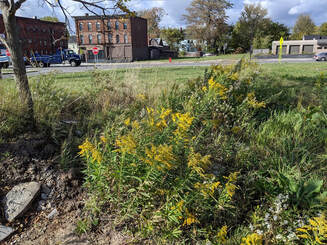
Many Rust Belt cities such as Buffalo experienced depopulation in the second half of the 20th Century, leaving many properties abandoned and causing serious social, political and ecological problems. To address these problems, many cities have turned to the demolition of these properties and subsequent creative reuse of the land (e.g. urban farming). These reuses have a variety of ecological co-benefits such as stormwater management. Our lab works on understanding how vacant lot demolition and regreening impacts the hydrology and biogeochemistry of urban Buffalo. We are contrasting different land reuse intensities, from mown grass to urban farming, to see how these practices alter carbon and nitrogen cycling in the subsurface. We are particularly interested in denitrification and other redox-sensitive processes, and we are using an observational, field-based approach to tackle these questions. This work is led by M.S. student Philip Conrad and is funded by the NYS Water Resources Institute.
Many Rust Belt cities such as Buffalo experienced depopulation in the second half of the 20th Century, leaving many properties abandoned and causing serious social, political and ecological problems. To address these problems, many cities have turned to the demolition of these properties and subsequent creative reuse of the land (e.g. urban farming). These reuses have a variety of ecological co-benefits such as stormwater management. Our lab works on understanding how vacant lot demolition and regreening impacts the hydrology and biogeochemistry of urban Buffalo. We are contrasting different land reuse intensities, from mown grass to urban farming, to see how these practices alter carbon and nitrogen cycling in the subsurface. We are particularly interested in denitrification and other redox-sensitive processes, and we are using an observational, field-based approach to tackle these questions. This work is led by M.S. student Philip Conrad and is funded by the NYS Water Resources Institute.
Geomorphic Controls on Riparian Denitrification
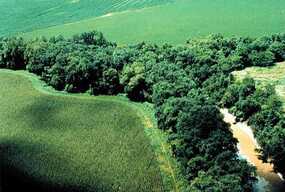
Near-stream areas (riparian zones) have long been recognized as hotspots of various biogeochemical processes that can alter the amounts of nutrient pollution that freshwaters receive. Denitrification in riparian zones substantially reduces nitrogen pollution in freshwaters, but not all riparian zones are created equal. Denitrification requires the confluence of soil nitrogen, soil carbon and anaerobic conditions. In this project, we are using a combination of remote sensing and reactive transport modelling approaches to identify landscape hotspots of denitrification potential and determine how river network configuration alters the prevalence of hotspots. This work is in collaboration with Nandita Basu at the University of Waterloo.
Near-stream areas (riparian zones) have long been recognized as hotspots of various biogeochemical processes that can alter the amounts of nutrient pollution that freshwaters receive. Denitrification in riparian zones substantially reduces nitrogen pollution in freshwaters, but not all riparian zones are created equal. Denitrification requires the confluence of soil nitrogen, soil carbon and anaerobic conditions. In this project, we are using a combination of remote sensing and reactive transport modelling approaches to identify landscape hotspots of denitrification potential and determine how river network configuration alters the prevalence of hotspots. This work is in collaboration with Nandita Basu at the University of Waterloo.
Past Projects:
River Network Structure and Agricultural Nitrogen Export
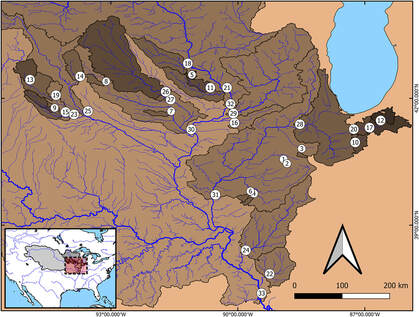
Nitrogen pollution in the Mississippi is one of the most vexing long-term water quality issues. Often, the relationship between river flow (discharge) and the concentration of solutes (such as nitrogen) are used to infer the processes driving the mobilization of these solutes into waterways. These efforts can be confounded by the fact that river network structure can profoundly alter concentration-discharge dynamics, though, especially at larger spatial scales. In this work, we examined the Upper Mississippi River basin (492,000 sq. km.) to elucidate how land use and river network structure jointly control nitrate concentration-discharge relationships. This work was a data synthesis effort, in which we reanalyzed publicly-available water quality, hydrography and land use datasets.
Marinos, R. E., Van Meter, K. J., Basu, N. B. (2021) Is the River a Chemostat?: Scale Versus Land Use Controls on Nitrate Concentration-Discharge Dynamics in the Upper Mississippi River Basin. Geophysical Research Letters. doi:10.1029/2020GL087051
Nitrogen pollution in the Mississippi is one of the most vexing long-term water quality issues. Often, the relationship between river flow (discharge) and the concentration of solutes (such as nitrogen) are used to infer the processes driving the mobilization of these solutes into waterways. These efforts can be confounded by the fact that river network structure can profoundly alter concentration-discharge dynamics, though, especially at larger spatial scales. In this work, we examined the Upper Mississippi River basin (492,000 sq. km.) to elucidate how land use and river network structure jointly control nitrate concentration-discharge relationships. This work was a data synthesis effort, in which we reanalyzed publicly-available water quality, hydrography and land use datasets.
Marinos, R. E., Van Meter, K. J., Basu, N. B. (2021) Is the River a Chemostat?: Scale Versus Land Use Controls on Nitrate Concentration-Discharge Dynamics in the Upper Mississippi River Basin. Geophysical Research Letters. doi:10.1029/2020GL087051
Ecosystem Recovery from Acid Rain: Carbon and Nitrogen Cycling in the Soil-Stream Continuum
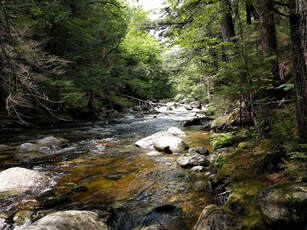
While acid rain is a wonderful example of an environmental problem that has been solved through collective action, forests across the developed world are still dealing with the legacies of over a century of intense acid deposition. Many of these forests are just beginning to recover from acid deposition, fifty years after acid rain peaked, and the future extent and trajectory of this recovery remains unclear. In my dissertation work, I examined how watershed carbon and nitrogen cycling accelerated as a forest recovered from acid rain. I did this work in the context of an acid rain recovery experiment at Hubbard Brook Experimental Forest (NH), where an 11 ha acid-impacted watershed was treated with calcium silicate to ameliorate the impacts of acid rain.
Marinos, R. E. and Bernhardt, E. S. (2018) Soil carbon losses due to higher pH offset vegetation gains due to calcium enrichment in an acid mitigation experiment. Ecology, 99: 2363-2373. doi:10.1002/ecy.2478
Marinos, R. E., Campbell, J. C., Driscoll, C. T., Likens, G. E., McDowell, W. H., Rosi, E. J., Rustad, L. E., and Bernhardt, E. S. (2018) Give and Take: Watershed acid remediation increases stormflow nitrogen export but increases baseflow in-stream nitrogen retention. Environmental Science and Technology, 52 (22): 13155–13165. doi: 10.1021/acs.est.8b03553